

What Is Prompt Engineering? How to Get Better Results from AI Tools
If you have used AI tools like ChatGPT or Gemini, you may have noticed something interesting. Sometimes the answers are very clear, useful, and detailed. At other times, the responses feel too generic, incomplete, or not exactly what you were expecting.
This difference is not random. In most cases, it depends on how you ask your question.
Many people assume that AI tools automatically understand what they mean. In reality, these systems depend heavily on the input they receive. The quality of the output is directly related to the clarity of the input. This is where the concept of Prompt Engineering becomes important.
What Is Prompt Engineering?
Prompt Engineering is the process of writing clear and structured instructions to get better results from AI systems.
A “prompt” is simply the input you give to an AI tool. It can be a question, a command, or a description of what you want. While this sounds simple, small changes in how you write your prompt can significantly change the quality of the response.
For example, if you ask “Explain AI,” the system may provide a very general answer. However, if you ask “Explain Artificial Intelligence in simple English with real-life examples for beginners,” the response becomes more focused and useful.
Both prompts are asking for the same topic, but the second one gives more context and direction. Prompt Engineering is about learning how to provide that clarity so the AI can respond more effectively.
Why Prompt Engineering Matters
AI models such as ChatGPT or Gemini generate responses based on patterns learned from large amounts of data. They do not truly understand your intention in the same way a human does. Instead, they try to predict the most relevant response based on the words you provide.
Because of this, unclear or vague prompts often lead to generic answers. On the other hand, well-structured prompts help the system understand your goal more accurately.
When you write better prompts, you can guide the AI to produce responses that are more detailed, more relevant, and easier to use. This can save time, reduce frustration, and improve productivity in daily tasks.
In simple terms, Prompt Engineering helps you get the best value from AI tools.
Understanding the Difference with a Simple Example
Consider a simple question about programming.
If you ask, “Tell me about Java,” the response will likely be broad and may include many details that are not useful for you.
Now compare that with a more specific prompt: “Explain Java in simple terms for a beginner with one real-world example and key features.”
The second prompt provides clarity about the audience, the level of explanation, and the expected structure. As a result, the response becomes more targeted and easier to understand.
This example shows that the effectiveness of AI is not only about the technology itself, but also about how we interact with it.
Key Elements of a Good Prompt
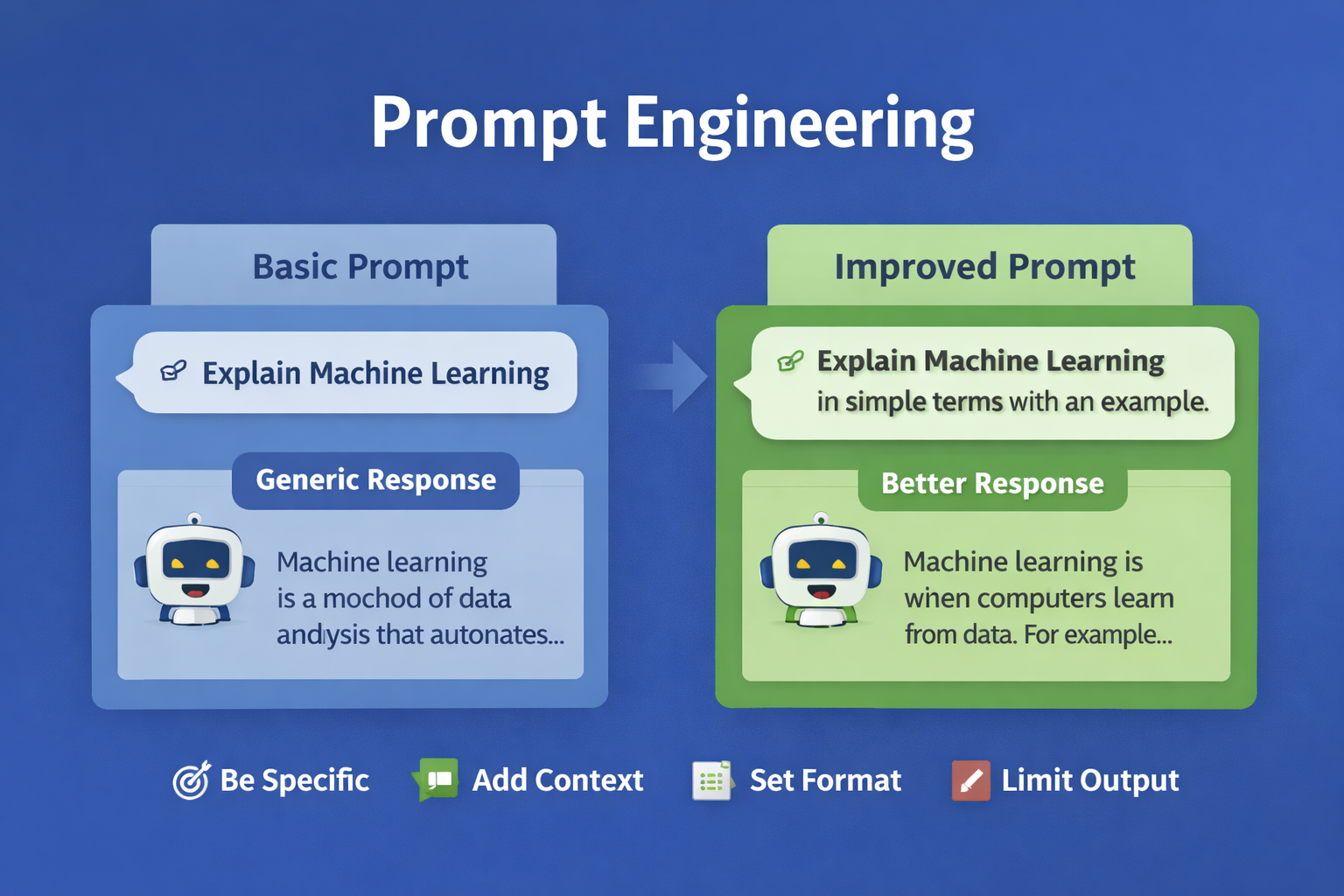
A good prompt usually contains a few important elements that help the AI understand your requirement clearly.
The first element is clarity of instruction. You should clearly mention what you want the AI to do. Instead of writing a vague request, use specific language that defines your expectation.
The second element is context. Providing background information helps the AI adjust its response. For example, mentioning that you are a beginner will result in a simpler explanation.
The third element is output format. You can guide the AI by specifying how the answer should be structured. For example, you can ask for bullet points, short paragraphs, or step-by-step explanations.
The fourth element is constraints. You can limit the response by defining word count, tone, or level of detail. This ensures that the output matches your requirement more closely.
When these elements are combined, the quality of the response improves significantly.
Different Types of Prompts
There are multiple ways to write prompts depending on the situation.
An instruction-based prompt is the most direct form. In this case, you clearly tell the AI what you want. For example, you might ask the system to explain a concept, write a summary, or generate an idea.
A role-based prompt involves assigning a role to the AI. For example, you can ask the AI to act as a teacher, a software engineer, or a content writer. This often helps in getting responses that match a specific style or perspective.
An example-based prompt includes a sample output that you want the AI to follow. This is useful when you want a specific structure or format in the response.
A step-by-step prompt asks the AI to break down a problem into smaller steps. This is helpful when learning new concepts or solving complex problems.
Using different types of prompts allows you to control how the AI responds in different situations.
Real-Life Applications of Prompt Engineering
Prompt Engineering is not limited to technical users. It is useful for anyone who uses AI tools in daily life.
Students can use it to simplify complex topics, generate notes, and prepare for exams. Professionals can use it to write emails, create presentations, and summarize reports. Developers can use it to generate code, debug errors, and understand technical concepts.
Content creators can use it to write articles, generate social media content, and brainstorm ideas. Even business owners can use it for customer communication, planning, and decision-making.
In all these scenarios, the quality of results depends heavily on how the prompt is written.
Common Mistakes to Avoid
Many beginners make simple mistakes that reduce the effectiveness of AI tools.
One common mistake is using very short or vague prompts. When the input lacks clarity, the output becomes generic and less useful.
Another mistake is not providing context. Without knowing the user’s level or goal, the AI cannot tailor its response appropriately.
Some users also expect perfect results in one attempt. In practice, refining the prompt step by step often leads to better outcomes. Prompt Engineering is an iterative process, not a one-time action.
Avoiding these mistakes can significantly improve your experience with AI tools.
Improving Prompts Step by Step
To understand how prompts can be improved, consider a simple example.
A basic prompt like “Explain APIs” will produce a general response. If we improve it to “Explain APIs in simple terms with one real-world example,” the answer becomes more focused.
We can further improve it by writing, “Explain APIs in simple English for beginners with one real-world example and common use cases.” Now the AI has a clear idea of the audience, style, and content.
This gradual improvement shows how adding clarity step by step leads to better results.
Why Prompt Engineering Is Becoming a Key Skill
As AI tools become more common, the ability to use them effectively will become an important skill.
In the past, learning how to use search engines, computers, and smartphones became essential for daily life. Similarly, understanding how to communicate with AI systems will become a basic digital skill in the coming years.
People who can write effective prompts will be able to work faster, solve problems more efficiently, and make better use of available tools. This skill will be valuable across all industries, not just in technology.
Final Thoughts
Prompt Engineering is not about complex programming or advanced technical knowledge. It is about asking better questions and providing clear instructions.
AI tools are powerful, but they depend on how we use them. When we learn to write clear, structured, and thoughtful prompts, the quality of results improves significantly.
In simple terms, better communication with AI leads to better outcomes.
Next Article in This Series
How to Start Using AI in Your Daily Life and Work (Practical Guide)
Like and Share
If you found this article helpful, share it with your friends and family, and tap the like button to support more such content.